
Singapore to Add Nearly 40,000 New Preschool Places in Five Years; 80% of Children to Receive Government Subsidies
Click:
Time:2024-11-26 00:00:00
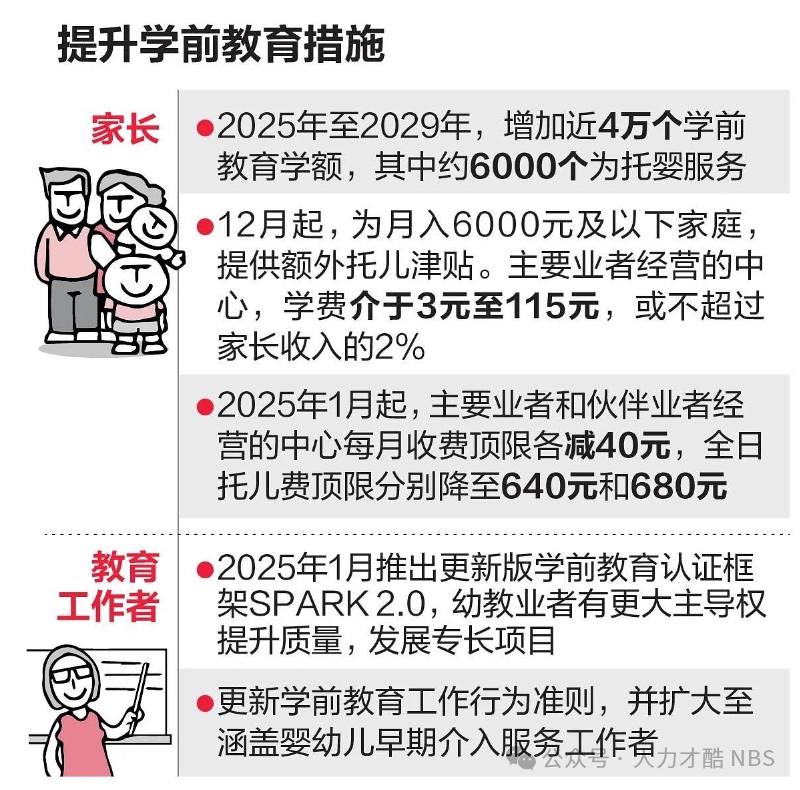
'Over the next five years, the Government will add nearly 40,000 new preschool places, including childcare centres and preschool hubs in new HDB estates. Around 6,000 of these new places will be for infant care services to meet the childcare needs of local families.'
Masagos Zulkifli, Minister for Social and Family Development and Second Minister for Health, announced this plan at a preschool celebration event on 2 November. He shared that the Early Childhood Development Agency (ECDA) has partnered with five major operators to create 60,000 preschool places over the past decade. From 2025 to 2029, ECDA will continue collaborating with these operators to add nearly 40,000 more places to meet rising demand.
This will ensure government-supported preschool centres can serve 80% of children, up from the current 65%. The Government had previously set the target of raising this coverage rate to 80%.
This expansion will also create abundant job opportunities for preschool educators. Opportunities are available not only for Singapore citizens but also open wide doors for foreign professionals.
There are five major government-partnered preschool operators.
In addition, to encourage lower-income families to enrol their children in preschools, the Government has introduced additional childcare subsidies for children from all families with a monthly household income of S$6,000 or less, regardless of whether the mother is employed. Masagos Zulkifli stated that this subsidy will take effect this December. It is estimated that parents will pay between S$3 and S$115 per month at centres run by the main operators, capped at 2% of household income. Fees will be further reduced next year, benefiting more than 17,000 additional children.
Starting from 9 December, parents may submit subsidy applications to ECDA in phases via the LifeSG app. This replaces the previous process where parents had to fill in physical forms for preschool centres to submit on their behalf.
Revamped SPARK Accreditation: Empowering Preschool Operators to Drive Quality Improvement with Greater Flexibility
To grant preschool operators greater autonomy to raise service quality, ECDA will launch the updated preschool accreditation framework, SPARK 2.0, next January.
Under the new framework, preschool centres will no longer be bound by uniform assessment criteria. Instead, quality evaluation will be tailored to each centre’s individual programmes. Once accredited under SPARK, centres can carry out targeted improvements in selected areas. They only need to submit annual self-assessments and improvement plans, instead of renewing their accreditation every six years as required previously. Centres may also apply for higher-tier accreditation once they are ready.
Masagos Zulkifli remarked: “The new framework places greater emphasis on teaching and learning. It empowers preschool centres to flexibly develop niche programmes and gives them more autonomy to uplift quality… Assessments will be less restrictive, encouraging centres to reflect on programme design and objectives, and innovate their curricula according to the needs of the children they serve and their organisational goals.”
First introduced in 2011, SPARK was designed to raise standards across the early childhood sector. To date, approximately 1,000 centres have obtained SPARK accreditation, accounting for 60% of the industry.
Furthermore, authorities have updated the Code of Professional Conduct for Early Childhood Professionals. The scope has been extended to cover early intervention practitioners working with infants and young children. Early intervention workers can refer to this code to guide their interactions with children with developmental needs.
The Code of Professional Conduct for Early Childhood Professionals was first launched by the Singapore Preschool Teachers Association in 2004. It outlines the core values and other requirements expected of early childhood educators. The updated code clearly defines practitioners’ responsibilities towards key stakeholders including children, families and peers. Case studies are also attached to guide educators in applying the code in practice.
In recent years, the government has invested resources to expand childcare services while keeping fees affordable. Authorities previously announced that starting next January, the monthly fee cap at centres run by main operators and partner operators will be reduced by S$40 each. The maximum monthly fee for full-day childcare will drop to S$640 and S$680 respectively.
A young adult who plans to have a baby in Singapore this year welcomed the government’s plan to build more childcare centres. He shared in an interview that the expansion will better cater to the needs of young families. Meanwhile, the quality of government-supported preschool centres remains critical. Operators must ensure well-rounded curricula and services to deliver high-quality options for parents.

点击右上角
分享给朋友吧







 Long by picture save/share
0

By choosing Rongyan Talent Service, you get professional, full-set solutions and a stable long-term partnership. We grow together and share mutual success.
Contact Person: Manager Liu
Consultation Hotline:18560668508
Contact Email:bowen@manpowerku.cn
Company Address: No.51 Taiping Road, Shinan District, Qingdao City, Shandong Province, China
Qingdao Rongyan Talent Service Co., Ltd.|Human Resources|Overseas Study|Overseas Employment Hotline:18560668508 Address: No.51 Taiping Road, Shinan District, Qingdao City, Shandong Province
Copyright © Qingdao Rongyan Talent Service Co., Ltd. All Rights Reserved.
Qingdao Rongyan Talent Service Co., Ltd.|Human Resources|Overseas Study|Overseas Employment Hotline:18560668508 Address: No.51 Taiping Road, Shinan District, Qingdao City, Shandong Province
Copyright © Qingdao Rongyan Talent Service Co., Ltd. All Rights Reserved.
Qingdao Rongyan Talent Service Co., Ltd.|Human Resources|Overseas Study|Overseas Employment Hotline:18560668508 Address: No.51 Taiping Road, Shinan District, Qingdao City, Shandong Province
Copyright © Qingdao Rongyan Talent Service Co., Ltd. All Rights Reserved.
By choosing Rongyan Talent Service, you get professional, full-set solutions and a stable long-term partnership. We grow together and share mutual success.
Contact Person: Manager Liu
Consultation Hotline:+8618560668508
Contact Email:bowen@manpowerku.cn
Company Address: No.51 Taiping Road, Shinan District, Qingdao City, Shandong Province, China
|Human Resources|Overseas Study|Overseas Employment Hotline:18560668508 Copyright © Qingdao Rongyan Talent Service Co., Ltd. All Rights Reserved. 鲁ICP备2023020946号-2
