
Only 20% of Undergraduates from Shanghai Universities Secure Jobs? How Many Choose Overseas Study?
Click:
Time:2023-05-17 00:00:00
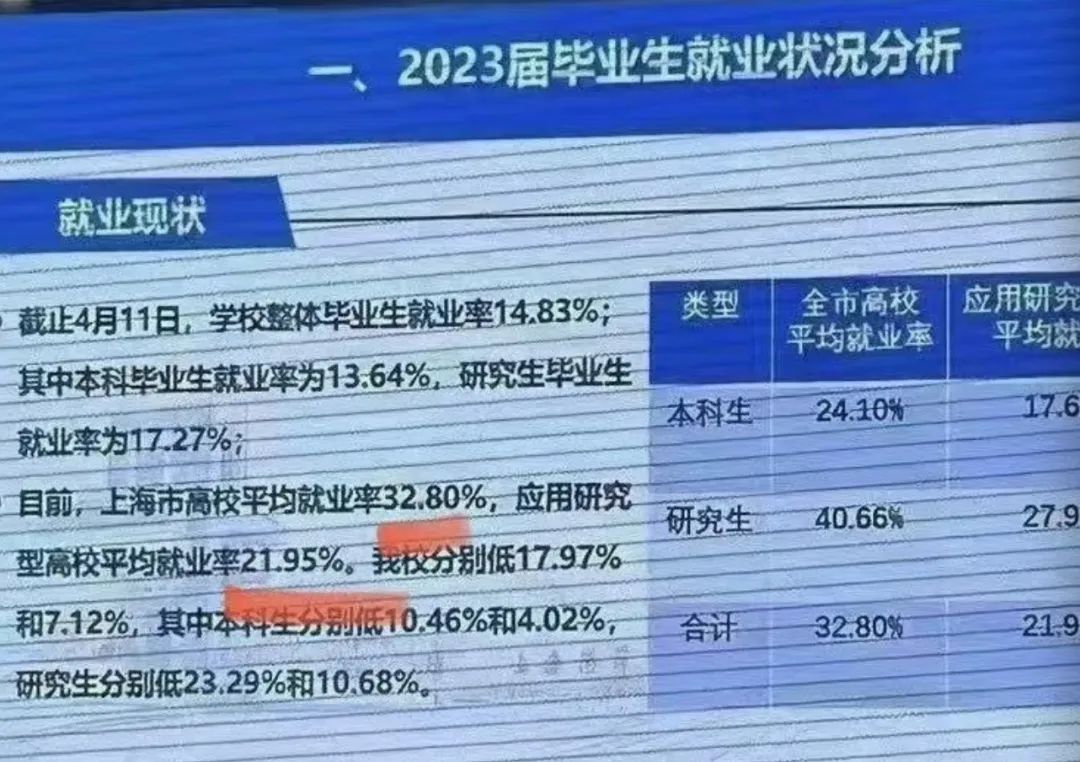
Recently, a chart analysing the employment status of 2023 fresh graduates has circulated online and sparked heated debate.
The chart is allegedly leaked internally from Shanghai Ocean University. It shows that as of April 11, the university’s graduate employment rate stood at only 14.83%. According to the chart, the average undergraduate employment rate across all higher education institutions in Shanghai was merely 24.10%, while the postgraduate employment rate was just 40.66%.
Most people’s first reaction upon seeing these figures would probably be: can this be true? The credibility of this leak remains unconfirmed, and no official response has been released. It is possible that the data will later be deemed inaccurate. Nevertheless, the fact that this issue was discussed at an internal meeting indicates that the employment situation at universities is undoubtedly severe.
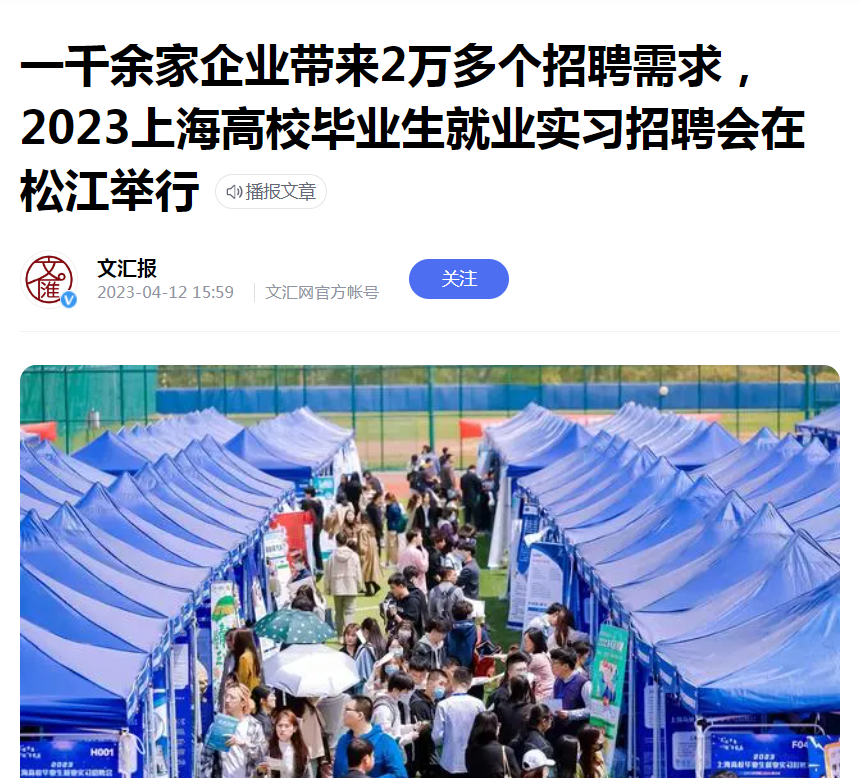
The low employment rate stems from multiple factors. Some believe the poor employment performance of Shanghai Ocean University may result from its limited range of majors and the downturn in ocean foreign trade. In addition, some students have unrealistic expectations. They overestimate the reputation of their alma mater. When they find fierce competition in the job market, they end up staying unemployed or preparing for the postgraduate entrance exam.
So here comes the question: where do those unemployed undergraduates go after graduation?
02
The most authoritative source to learn about graduates’ destinations is the annual Graduate Employment Quality Report published by universities.
Key universities across China release their graduate employment data to the public every year, usually early in the following calendar year. Data for 2023 would not be available until the next year. Therefore, we will look at the 2021 and 2022 employment statistics of several prestigious universities in Shanghai.
Shanghai Jiao Tong University
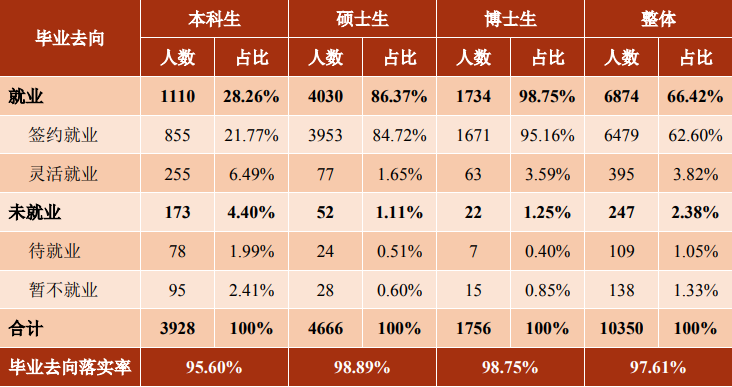
As of November 30, 2022, the employment implementation rate for full-time graduates of Shanghai Jiao Tong University’s Class of 2022 stood at 97.61%. Among them, 23.45% pursued further studies in mainland China, 7.75% chose to study overseas or in Hong Kong, Macao and Taiwan regions, and 62.60% secured signed employment contracts. Only 28.26% of undergraduate graduates opted for direct employment!
The main countries and regions chosen by students for further study abroad include the United States (410 students, accounting for 54.09%), Hong Kong of China (111 students, 14.64%), the United Kingdom (62 students, 8.18%), Singapore (49 students, 6.46%) and Japan (24 students, 3.17%).
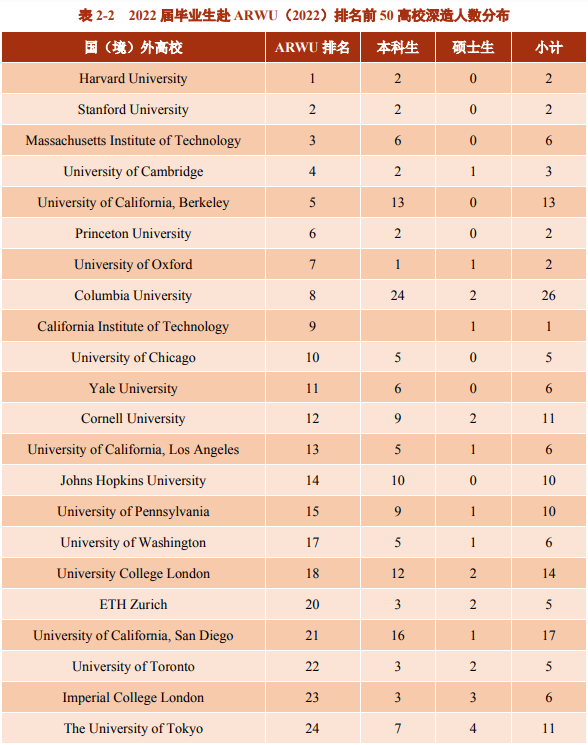
Among the Class of 2022 graduates admitted to universities ranked within the top 50 in the ARWU 2022 ranking, the three US institutions with the largest intake were the University of Michigan, Ann Arbor (81 admissions), Columbia University (26 admissions) and the University of Illinois at Urbana-Champaign (23 admissions). The three UK universities with the most admissions were UCL (14), the University of Edinburgh (7) and Imperial College London (6).
Tongji University
As of November 22, 2022, the graduate destination implementation rate for the Class of 2022 stood at 96.05%.
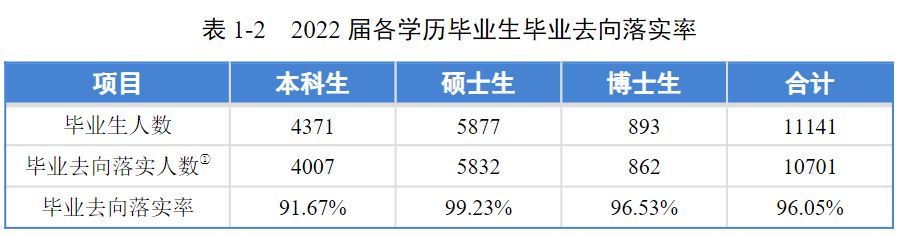
Note: The number of graduates with confirmed destinations = those with job assignment + contract employment + national and local employment programs + flexible employment + targeted and commissioned training + further study in China + further study overseas or in Hong Kong, Macao and Taiwan regions.
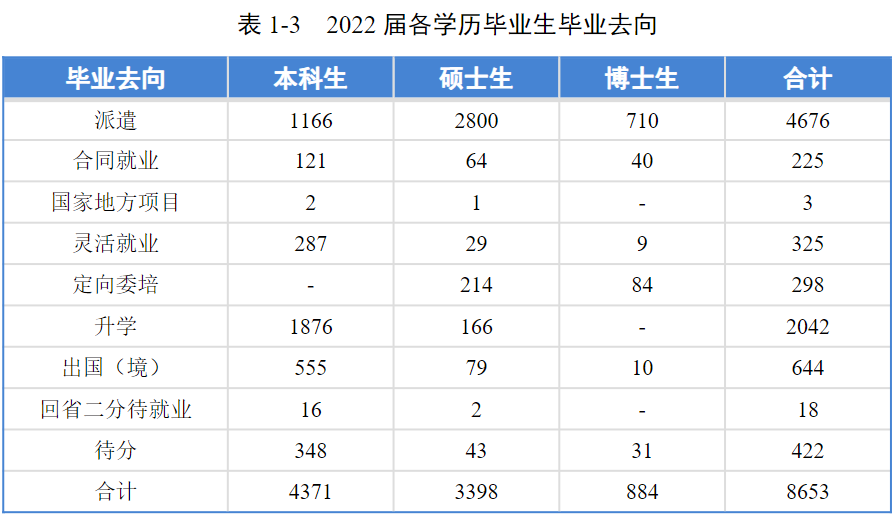
Among the Class of 2022 graduates, a total of 644 registered to pursue further studies overseas or in Hong Kong, Macao and Taiwan regions. The top three destinations were the United States (131 graduates), Germany (121 graduates) and the United Kingdom (108 graduates), accounting for 55.90% of all graduates studying abroad.
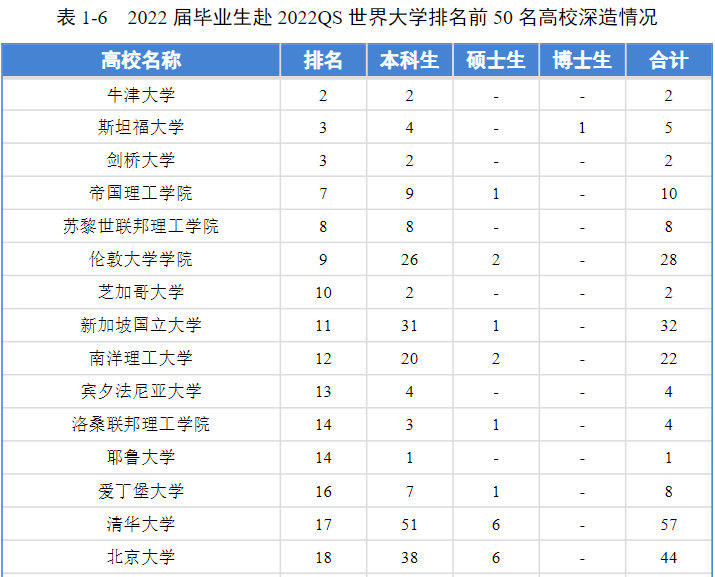
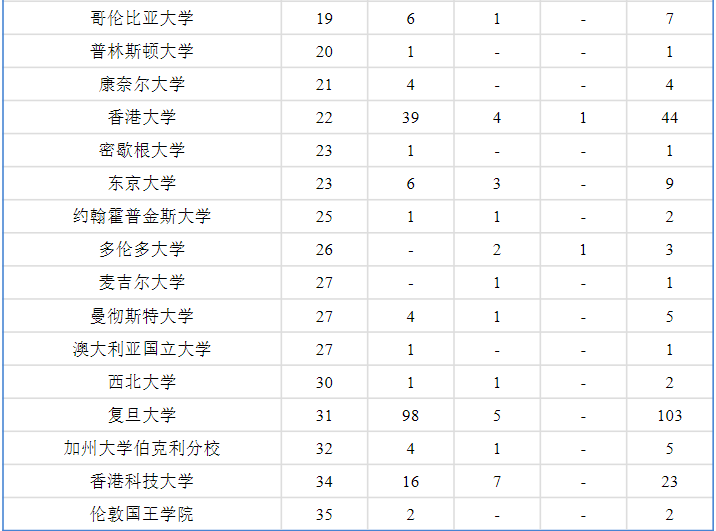
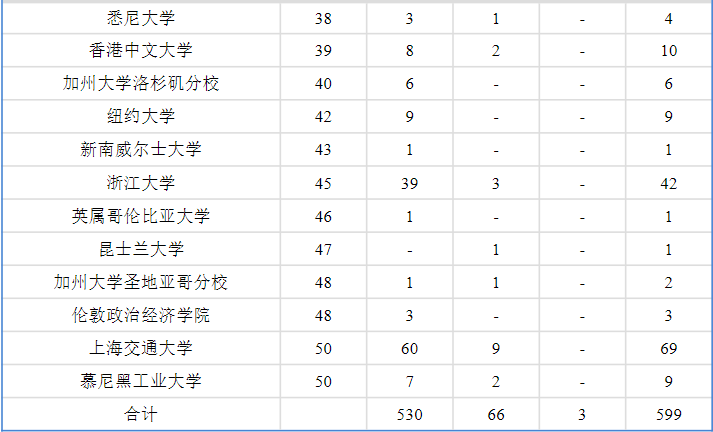
Popular overseas universities ranked within the QS World University Rankings top 50 with large admission numbers include the University of Hong Kong (44 students, Hong Kong of China), the National University of Singapore (32 students, Singapore), University College London (UCL, 28 students, UK), Nanyang Technological University (22 students, Singapore), Imperial College London (10 students, UK), and the Chinese University of Hong Kong (10 students, Hong Kong of China).
Fudan University
As of October 31, 2021, the overall graduate destination implementation rate for the Class of 2021 stood at 98.08%. See the chart below for detailed statistics on graduate destinations.
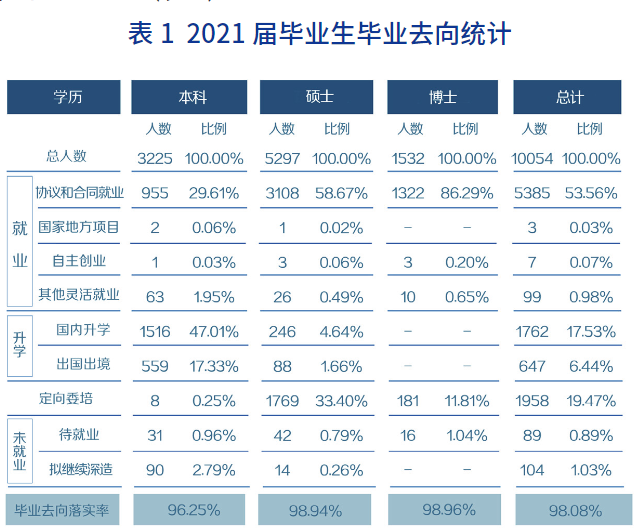
647 graduates from the Class of 2021 pursued further studies overseas or in Hong Kong, Macao and Taiwan regions. Their study destinations spanned 22 countries and regions, including the United States (32.61%), Hong Kong of China (16.38%), the United Kingdom (15.77%) and Singapore (11.90%). Among them, 559 were undergraduate students, accounting for 17.33% of all undergraduates.
A total of 389 graduates of the Class of 2021 pursued further education at world top-50 universities, making up 60.12% of all students studying abroad. Among this group, 348 were undergraduates, representing 62.25% of all undergraduate overseas students.
03
By reviewing the graduate destination data of these three Shanghai-based 985 universities, we can draw the following observations:
- More than half of the undergraduates choose to pursue further education after graduation.
- Most students opting for overseas further study are undergraduates.
- The United States, Hong Kong of China, the United Kingdom and Singapore are the primary destinations for overseas study.
In fact, a major reason why many undergraduates choose further studies is the tough job market for fresh graduates. Hence some students consider boosting their competitiveness through overseas education. While studying abroad, they can acquire professional knowledge and skills, and build cross-cultural communication and language capabilities, all of which will positively support their future career development.

点击右上角
分享给朋友吧







 Long by picture save/share
0

By choosing Rongyan Talent Service, you get professional, full-set solutions and a stable long-term partnership. We grow together and share mutual success.
Contact Person: Manager Liu
Consultation Hotline:18560668508
Contact Email:bowen@manpowerku.cn
Company Address: No.51 Taiping Road, Shinan District, Qingdao City, Shandong Province, China
Qingdao Rongyan Talent Service Co., Ltd.|Human Resources|Overseas Study|Overseas Employment Hotline:18560668508 Address: No.51 Taiping Road, Shinan District, Qingdao City, Shandong Province
Copyright © Qingdao Rongyan Talent Service Co., Ltd. All Rights Reserved.
Qingdao Rongyan Talent Service Co., Ltd.|Human Resources|Overseas Study|Overseas Employment Hotline:18560668508 Address: No.51 Taiping Road, Shinan District, Qingdao City, Shandong Province
Copyright © Qingdao Rongyan Talent Service Co., Ltd. All Rights Reserved.
Qingdao Rongyan Talent Service Co., Ltd.|Human Resources|Overseas Study|Overseas Employment Hotline:18560668508 Address: No.51 Taiping Road, Shinan District, Qingdao City, Shandong Province
Copyright © Qingdao Rongyan Talent Service Co., Ltd. All Rights Reserved.
By choosing Rongyan Talent Service, you get professional, full-set solutions and a stable long-term partnership. We grow together and share mutual success.
Contact Person: Manager Liu
Consultation Hotline:+8618560668508
Contact Email:bowen@manpowerku.cn
Company Address: No.51 Taiping Road, Shinan District, Qingdao City, Shandong Province, China
|Human Resources|Overseas Study|Overseas Employment Hotline:18560668508 Copyright © Qingdao Rongyan Talent Service Co., Ltd. All Rights Reserved. 鲁ICP备2023020946号-2
