
Report Shows New Graduates Have a Distinct Preference for Job Stability
Click:
Time:2023-05-17 00:00:00
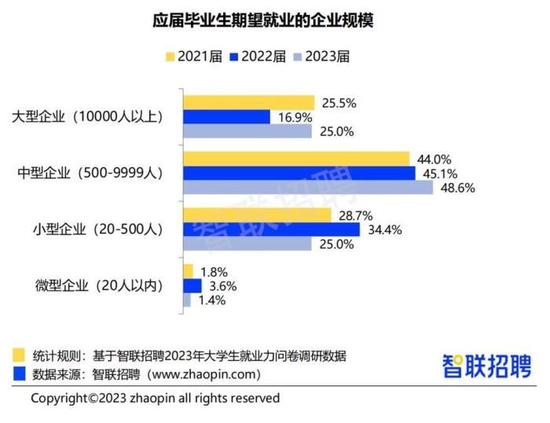
Enterprise Size Preferred by New Graduates for Employment
Source: 2023 Report on College Graduates’ Employability
Beijing, May 5 (Chinanews) — The recently released 2023 Report on College Graduates’ Employability shows that the digital economy sector remains a hot topic among graduates, while job stability has become a key consideration in their job search.
The survey was conducted among final-year students from mid-March to mid-April this year. Results indicate that the proportion of the 2023 cohort choosing traditional employment rose to 57.6% from 50.4% in the previous year. The share of those opting for freelance work dropped from 18.6% to 13.2%, and the percentage choosing further domestic study fell from 9.3% to 4.9%.
According to the report, the digital economy serves as a new driving force for economic growth. Graduates with digital skills enjoy greater advantages in the job market, making the trend of “arts graduates switching to coding” widely discussed. Among non-digital majors pursuing further studies, roughly 15% decided to switch to digital-related disciplines. Meanwhile, 67% of respondents expressed interest in digital majors but lacked foundational knowledge. This demonstrates strong willingness among graduates to shift toward digital fields amid the growth of the digital economy, yet insufficient prior learning stands as a major barrier.
For job seekers, state-owned enterprises (SOEs) remain the top employment choice, favoured by 46.7% of respondents. In terms of enterprise size, medium-sized companies are still popular among graduates, attracting nearly half of all respondents, up 3.5% year-on-year. Large enterprises were chosen by 25% of graduates, an increase of about 8 percentage points from last year and equal to the 2021 level.
Regarding preferred industries, 25% of the 2023 graduates hoped to work in IT, communications, electronics and the internet sector, a slight year-on-year rebound.
When it comes to cities, 30% of graduates expected to work in first-tier cities and another 30% preferred new first-tier cities. Second-tier and third-tier cities accounted for approximately 27% and 10% respectively. In addition, highly educated talents show a clear preference for new first-tier cities, which will help supply talent for the future development of these cities.
As for factors graduates prioritise in job hunting, salary and benefits remain the primary concern, cited by nearly 70% of respondents. Job stability ranks second at around 40%, rising by 4.5% from last year and marking a three-year consecutive increase. It is evident that new graduates demonstrate a strong preference for stability, which has grown increasingly important during their job search.
In terms of job search channels, nearly 90% of graduates use recruitment websites, making them the primary platform for university leavers. Over 70% of graduates took part in video interviews, a rise of roughly 9% year-on-year. Boasting high efficiency, time and cost savings, and freedom from geographic restrictions, video interviews deliver a positive experience for both employers and candidates.

点击右上角
分享给朋友吧







 Long by picture save/share
0

By choosing Rongyan Talent Service, you get professional, full-set solutions and a stable long-term partnership. We grow together and share mutual success.
Contact Person: Manager Liu
Consultation Hotline:18560668508
Contact Email:bowen@manpowerku.cn
Company Address: No.51 Taiping Road, Shinan District, Qingdao City, Shandong Province, China
Qingdao Rongyan Talent Service Co., Ltd.|Human Resources|Overseas Study|Overseas Employment Hotline:18560668508 Address: No.51 Taiping Road, Shinan District, Qingdao City, Shandong Province
Copyright © Qingdao Rongyan Talent Service Co., Ltd. All Rights Reserved.
Qingdao Rongyan Talent Service Co., Ltd.|Human Resources|Overseas Study|Overseas Employment Hotline:18560668508 Address: No.51 Taiping Road, Shinan District, Qingdao City, Shandong Province
Copyright © Qingdao Rongyan Talent Service Co., Ltd. All Rights Reserved.
Qingdao Rongyan Talent Service Co., Ltd.|Human Resources|Overseas Study|Overseas Employment Hotline:18560668508 Address: No.51 Taiping Road, Shinan District, Qingdao City, Shandong Province
Copyright © Qingdao Rongyan Talent Service Co., Ltd. All Rights Reserved.
By choosing Rongyan Talent Service, you get professional, full-set solutions and a stable long-term partnership. We grow together and share mutual success.
Contact Person: Manager Liu
Consultation Hotline:+8618560668508
Contact Email:bowen@manpowerku.cn
Company Address: No.51 Taiping Road, Shinan District, Qingdao City, Shandong Province, China
|Human Resources|Overseas Study|Overseas Employment Hotline:18560668508 Copyright © Qingdao Rongyan Talent Service Co., Ltd. All Rights Reserved. 鲁ICP备2023020946号-2
