
Why are a growing number of enterprises and public institutions opting for labor dispatch?
Click:
Time:2023-05-17 00:00:00
Why are a growing number of enterprises and public institutions opting for labor dispatch?
With the rapid development of modern enterprises, employment models among companies have become increasingly diverse. Thanks to advantages such as reduced workload and lower costs, many enterprises turn to labor dispatch to supplement their workforce. How much do you know about 'labor dispatch'?
What is Labor Dispatch?
Simply put, the feature of labor dispatch is that the user unit uses workers without directly recruiting them. Also known as staff leasing, labor dispatch works in this way: the user unit specifies the criteria and remuneration for required personnel to a labor dispatch agency. The agency then recruits suitable candidates from the market and assigns screened qualified workers to the user unit.
Under labor dispatch arrangements, the labor dispatch agency shall perform obligations to the workers, such as signing labor contracts with dispatched employees. Therefore, a labor relationship exists between the labor dispatch agency and the workers, while only a service relationship is formed between the actual user unit and the workers. (See figure below)
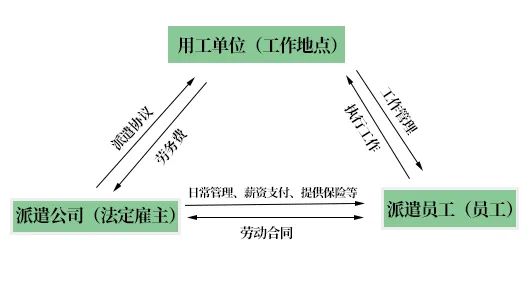
'Not seeking ownership, but availability' is a notable feature of labor dispatch. Since China adopted the market economy system, the labor dispatch system has gradually developed, marking a major reform of China’s employment system. Compared with traditional employment models, labor dispatch boasts substantial advantages.
Many enterprises now adopt labor dispatch to cut staffing costs and boost efficiency. What benefits does labor dispatch bring? What can enterprises gain from it?
1. Cut Down Labor Costs
When calculating the total expenditure for dispatched staff, user units take job performance into consideration, set wages based on market rates, and freely adjust the ratio of fixed and variable pay. The overall expenditure is far lower than that for permanent employees. Besides, there is no need to pay extra unplanned expenses for dispatched workers.
Special invoices for labor dispatch services can be counted as pre-tax costs for user units, further reducing the comprehensive expenditure compared with permanent staff.
2. Simplify HR Administration and Improve Management Efficiency
User units do not need to assign dedicated staff or departments to handle tedious HR work for dispatched employees. The labor dispatch company takes charge of recruitment, talent relocation, file transfer, mobility formalities, household registration settlement, employee file creation, payroll and bonus calculation and payment, social insurance enrollment and contributions, work injury applications, labor dispute resolution and other administrative HR tasks.
When employing dispatched workers, user units only need to formulate relevant management rules and conduct performance assessments based on work assignments. The decision on contract renewal upon expiry rests mainly with the user unit.
3. Flexible Staffing to Enhance Workforce Management Efficiency
Many organizations experience frequent business fluctuations. Labor dispatch allows them to scale up staff when business expands and downsize when business shrinks. Staff turnover is flexible and free from staffing quota restrictions. All entry and exit formalities are professionally handled by the dispatch company, which greatly disperses and mitigates employment risks.
The Labor Contract Law stipulates multiple scenarios under which employers shall sign open-ended labor contracts with employees. Labor dispatch serves as an effective way to address this concern.
Some enterprises have seasonal staffing needs. The labor dispatch model enables them to set up short-term, temporary and auxiliary positions according to actual business conditions.
4. Mitigate Labor Disputes and Protect Corporate Reputation
Guided by relevant Chinese laws, regulations and policies, user units sign service agreements with labor dispatch companies, while the dispatch companies sign employment contracts with recruited workers. A paid service relationship exists between user units and dispatched employees. In this way, user units can avoid direct labor disputes with the workers.
5. Screen Candidates and Build Talent Reserve
Enterprises can trial employees via labor dispatch to screen talent for the talent pool. This prevents hiring unqualified candidates and reduces turnover costs.
Labor dispatch companies operate standardized management systems. Professional staff file and analyze every staffing requirement and dismissal reason for their clients, so they can recruit more targeted candidates for future hiring needs. When the manpower demand reaches a certain scale, the dispatch firm will launch targeted training courses in cooperation with employment agencies and partner schools to guarantee workforce quality and raise the social employment rate.

It is critical to select a professional, authoritative and experienced human resources service provider.

点击右上角
分享给朋友吧







 Long by picture save/share
0

By choosing Rongyan Talent Service, you get professional, full-set solutions and a stable long-term partnership. We grow together and share mutual success.
Contact Person: Manager Liu
Consultation Hotline:18560668508
Contact Email:bowen@manpowerku.cn
Company Address: No.51 Taiping Road, Shinan District, Qingdao City, Shandong Province, China
Qingdao Rongyan Talent Service Co., Ltd.|Human Resources|Overseas Study|Overseas Employment Hotline:18560668508 Address: No.51 Taiping Road, Shinan District, Qingdao City, Shandong Province
Copyright © Qingdao Rongyan Talent Service Co., Ltd. All Rights Reserved.
Qingdao Rongyan Talent Service Co., Ltd.|Human Resources|Overseas Study|Overseas Employment Hotline:18560668508 Address: No.51 Taiping Road, Shinan District, Qingdao City, Shandong Province
Copyright © Qingdao Rongyan Talent Service Co., Ltd. All Rights Reserved.
Qingdao Rongyan Talent Service Co., Ltd.|Human Resources|Overseas Study|Overseas Employment Hotline:18560668508 Address: No.51 Taiping Road, Shinan District, Qingdao City, Shandong Province
Copyright © Qingdao Rongyan Talent Service Co., Ltd. All Rights Reserved.
By choosing Rongyan Talent Service, you get professional, full-set solutions and a stable long-term partnership. We grow together and share mutual success.
Contact Person: Manager Liu
Consultation Hotline:+8618560668508
Contact Email:bowen@manpowerku.cn
Company Address: No.51 Taiping Road, Shinan District, Qingdao City, Shandong Province, China
|Human Resources|Overseas Study|Overseas Employment Hotline:18560668508 Copyright © Qingdao Rongyan Talent Service Co., Ltd. All Rights Reserved. 鲁ICP备2023020946号-2
